In the Gentle Art of Making Enemies Whistler Argues That
James Abbot McNeill Whistler c. 1875
I've long admired Whistler's Nocturnes for their spare elegance, and subtle nods to Hiroshige's woodblock prints. What I didn't know is that it bankrupted poor Whistler, and was the subject of lawsuit controversy as unfortunate as modern daytime television. All that, and it was but a affair of gustation.
Whistler believed in "art for art's sake." Reverse to the predominant Victorian loquaciousness, he believed a painting need not be beleaguered by narrative, meaning, or moralities. To Whistler, a painting needed merely a quality of emotion produced from tone and colour. A painting needed only to be beautiful. Farther, he believed an elegant painting should have the lightest application of paint and the least amount of castor work, a new mode later called Japonisme, influenced past Japanese fine art and fashion. In "Nocturne in Black and Gold – The Falling Rocket" Whistler's work was then low-cal and unsaid that to the art critic John Ruskin, it looked completely without finish, or arts and crafts. The thin transparent washes, barely covering the weave of the linen, and his flecks of paint, and so proficient to wait effortless, was so grossly misunderstood by Ruskin that it effectively ruined Whistler's career as a painter.
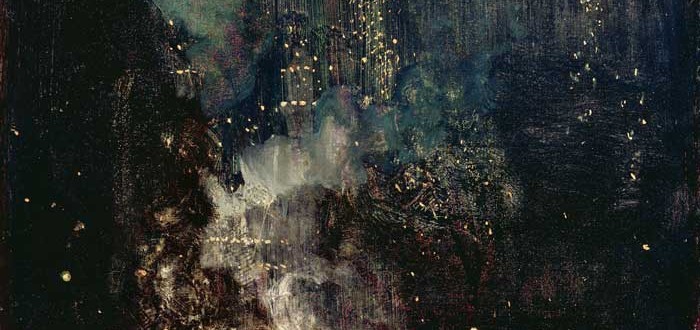 Detail ofNocturne in Black and Gold – The Falling Rocket
Excerpts from Wikipedia:
Whistler spent years perfecting his splatter technique. Eventually he possessed the ability to make an object or person with what appeared to be zilch more than a single flick of paint. Although Whistler's critics denounced his technique as reckless or defective artistic merit, information technology is notable that Whistler spent much of his time with meticulous details, often going and so far as to view his work through mirrors to ensure that no deficiencies were overlooked.
Nocturne in Blackness and Aureate – The Falling Rocket c. 1875 is near famously known as the inception of the lawsuit between Whistler and the art critic John Ruskin. Ruskin was not aware of the effort and theory that had gone into Nocturne in Black and Gold when he accused The Falling Rocket of being a public insult. He had denounced Whistler'south art as "accented rubbish."
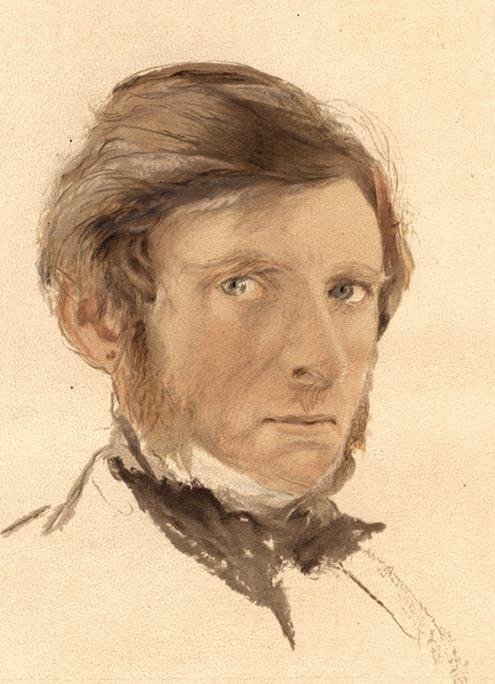
John Ruskin, self portrait in watercolor
"When dear and skill work together, expect a masterpiece." – said John Ruskin, who causeless Whistler'south work had neither beloved, nor skill.
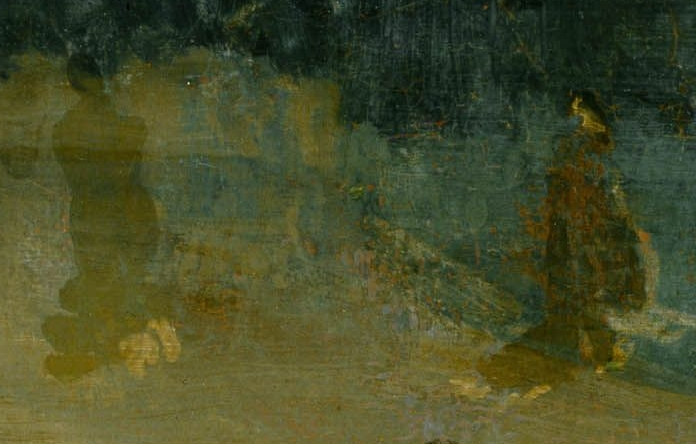
Detail of The Falling Rocket
Working against gimmicky inclinations for narrative (indicative of the heavy consumption of literature), Whistler tin can be seen arguing for painting's essential difference from literature within this work, as color and tone vanquish hints of narrative or moral allusion. Whistler'south focus was on coloristic effects equally a means of creating a particular sensation. More than that, a Nocturne is concerned with its depiction of space, seeking a item sense of void that seems to ascend only in the night time. As part of the Art for Art's Sake move, the artwork seeks to provide complex emotions that become across the technicalities of the imagery. Whistler believed that certain experiences were ofttimes best expressed by nuance and implication. These compositions were not designed to avoid the truth of a scene, but instead served as a means of reaching deeper, more than hidden truths. His artistic endeavors no longer concerned themselves with physical accuracy, seeking only to capture the essence of an intangible, personal and intimate moment. Whistler has been quoted as saying:
"If the homo who paints only the tree, or flower, or other surface he sees before him were an artist, the rex of artists would exist the lensman. It is for the creative person to exercise something beyond this."
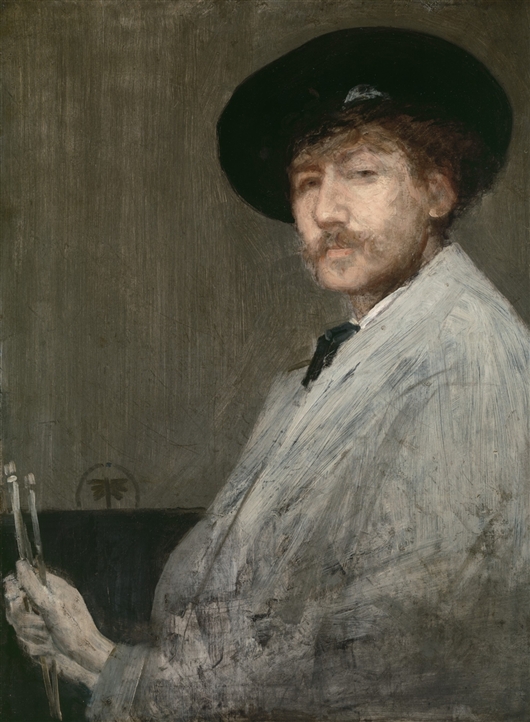
Whistler, self portrait
In essence, The Falling Rocket is the synthesis of a fireworks scene in London, and and then by no means does information technology aim to expect like it. Similar his other Nocturnes, the painting is meant to be seen as an organization, ready to invoke particular sensations for the audience.
Affronted byThe Falling Rocket, John Ruskin accused Whistler of "flinging a pot of paint in the public's face." Equally a leading fine art critic of the Victorian era, Ruskin's harsh critique of The Falling Rocket caused an uproar among owners of other Whistler works. Apace, it became shameful to have a Whistler piece, pushing the artist into greater financial difficulties. With his pride, finances, and the significance of his Nocturne at stake, Whistler sued Ruskin for libel in defense force. In court, he asked the jury to not view it as a traditional painting, but instead equally an creative arrangement. In his explanation, he insisted that the painting was a representation of the fireworks from the Cremorne Gardens. During the trial, Sir John Holker asked, "Not a view of the Cremorne?" to which Whistler was quoted as saying, "If information technology were a view of Cremorne, it would certainly bring nearly goose egg merely disappointment on the part of the beholders." Nonetheless, his case was not helped when The Falling Rocket was accidentally presented to trial upside down. His explanation of the limerick proved fruitless before the judge. The Ruskin vs. Whistler Trial, which took place on November 25 and 26, 1878, was disastrous for Whistler. While he did not lose, he only won a farthing. Afterwards all the court costs, he had no choice but to declare defalcation. Whistler was forced to pawn, sell, and mortgage everything he could go his hands on. Whistler included a transcript of the case in his 1890 volume The Gentle Art of Making Enemies.
Source: https://seattleartistleague.com/2016/12/30/whistler_ruskin/
0 Response to "In the Gentle Art of Making Enemies Whistler Argues That"
Postar um comentário