Is It Ever Too Late to Practice Martial Arts
 | |
| Focus | Weaponry |
|---|---|
| Hardness | Semi-contact |
| Country of origin | Nippon |
| Creator | - |
| Parenthood | kenjutsu |
| Olympic sport | No |
| Official website | www |
Kendo ( 剣道 , Kendō , lit. 'sword way', 'sword path' or 'manner of the sword') [ane] is a modern Japanese martial art, descended from kenjutsu (1 of quondam Japanese martial arts, swordsmanship), that uses bamboo swords (shinai) equally well every bit protective armor (bōgu).[two] Today, information technology is widely skilful within Nippon and has spread to many other nations across the world.
Kendo is an activity that combines martial arts practices and values with strenuous, sport-similar physical activity.
History [edit]

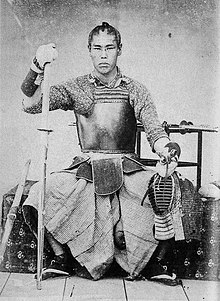
Swordsmen in Nihon established schools of kenjutsu [3] (the ancestor of kendo). These continued for centuries and form the ground of kendo practice today.[4] Formal kendo exercises known as kata were adult several centuries agone as kenjutsu practice for warriors. They are all the same studied today, in a modified form.[5]
The introduction of bamboo exercise swords and armor to sword training is attributed to Naganuma Shirōzaemon Kunisato ( 長沼 四郎左衛門 国郷 , 1688–1767) during the Shotoku Era (1711–1715). Naganuma adult the employ of this armor and established a training method using bamboo swords.[6]
Yamada Heizaemon Mitsunori (Ippūsai) ( 山田平左衛門光徳(一風斎) , 1638–1718), 3rd son of Naganuma and the 8th headmaster of the Kashima Shinden Jikishinkage-ryū Kenjutsu, is credited with improving the art with Japanese wooden and bamboo swords, according to his gravestone's inscription. He is also credited with refining the armor past calculation a metallic grille to the headpiece(men)(面) and thick cotton protective coverings to the gauntlets(kote)(小手).[7] Naganuma Sirozaemon Kunisato ( 長沼四郎左衛門国郷 , 1688-1767) inherited the tradition from his begetter Heizaemon in 1708, and the 2 of them collaborated to improve what would become modern kendo grooming armor.[six] [vii]
Shūsaku Narimasa Chiba ( 千葉 周作 成政 , 1792-1855), founder of the Hokushin Ittō-ryū Hyōhō (北辰一刀流兵法), introduced gekiken (撃剣) (full contact duels with bamboo swords and training armor) to the curriculum of tradition arts in the 1820s. Due to the large number of students of the Hokushin Ittō-ryū Hyōhō at the stop of the Edo period, the use of bamboo swords and armor equally a class of practice became popular. Mod kendo techniques, such as Suriage-Men and Oikomi-Men, were originally Hokushin Ittō-ryū techniques, were named by Chiba Shūsaku.[6] [eight] [ix] [10] After the Meiji Restoration in the tardily 1800s, Sakakibara Kenkichi popularized public gekiken for commercial gain, resulting in increased interest in kendo and kenjutsu.[eleven] [12]
In 1876, five years later on a voluntary surrender of swords, the government banned the utilise of swords by the surviving samurai and initiated sword hunts.[13] Meanwhile, in an endeavor to standardize the sword styles (kenjutsu) used past policemen, Kawaji Toshiyoshi recruited swordsmen from various schools to come upward with a unified swordsmanship manner.[xiv] This led to the rising of the Battotai (抜刀隊, lit. Drawn Sword Corps), consisting mainly of sword-wielding policemen. Yet, it proved hard to integrate all sword arts, leading to a compromise of ten practice moves (kata) for police training. This integration effort led to the development of modern kendo.[14] In 1878, Kawaji wrote a book on swordsmanship, Gekiken Saikō-ron (Revitalizing Swordsmanship), stressing sword styles should not disappear with modernization, simply should exist integrated every bit necessary skills for the police force. He draws a particular example from his feel with the Satsuma Rebellion. The Junsa Kyōshūjo (Patrolman's Grooming Institute), founded in 1879, provided a curriculum that allowed policemen to study gekiken during their off-hours. In the same year, Kawaji wrote some other book on swordsmanship, Kendo Saikō-ron (Revitalizing Kendo), defending the significance of such sword art training for the police.[fifteen] While Junsa Kyōshūjo remained agile just until 1881, the police continued to support such do.

Kendo at an agricultural schoolhouse in Japan effectually 1920

The Dai Nippon Butoku Kai (DNBK) was established in 1895 to promote martial arts in Nippon. Information technology changed the name of the sporting form of swordsmanship, gekiken, (Kyūjitai: 擊劍 and Shinjitai: 撃剣 , "hitting sword") to kendō in 1920.[4] [16]
Kendo (along with other martial arts) was banned in Japan in 1946 past the occupying powers. This was part of "the removal and exclusion from public life of militaristic and ultra-nationalistic persons" in response to the wartime militarization of martial arts education in Nihon. The DNBK was also disbanded. Kendo was immune to render to the curriculum in 1950, first equally "shinai contest" ( 竹刀競技 , shinai kyōgi ) and and then every bit kendo in 1952.[17] [18]

The All Japan Kendo Federation (AJKF or ZNKR) was founded in 1952, immediately after Nihon'due south independence was restored and the ban on martial arts in Nippon was lifted.[19] Information technology was formed on the principle of kendo not as a martial art, but as educational sport and it has connected to be practiced as such to this day.[20]
The International Kendo Federation (FIK) was founded in April 1970. It is an international federation of national and regional kendo federations, and the earth governing body for kendo. The FIK is a not-governmental organization, and information technology aims to promote and popularize kendo, iaido and jodo.[21]
The International Martial Arts Federation (IMAF), established in Kyoto 1952, was the showtime international arrangement founded since WWII to promote the evolution of martial arts worldwide. Today, IMAF includes kendo as i of the Japanese disciplines.[22]
Popular art in Japan [edit]

Inscribed in pop civilisation in Nihon, kendo has more than one meg followers. Since 2012, it has been one of the disciplines taught in Japanese colleges with judo and sado. The manufacture of armor and shinai is however the object of an artisanal practice and contributes to perpetuate a tradition of small traders.[23]
Kendo belonging to the deep culture participates in the formation of the popular classes and the elites. Ryutaro Hashimoto, Prime Minister of Nihon from 1996 to 1998, was 6th dan. He had a modest dojo set up in the finance ministry. He reports that "the practice of kendo is associated with success".[23] In June 1996, he promoted Japanese culture inside the framework of the G7 which takes place in Lyon thanks to the drive and the authenticity of the diplomatic relationship established by Mr. Louis Michallet, Consul Full general of Nippon, President-Founder of the Order Lyon-Japon.[24] Ryutaro Hashimoto and Jacques Chirac continued the arrangement from April 1997 to March 1998 of "The Twelvemonth of Japan in France", and inaugurated the Maison de la Culture du Japon in Paris.[25] Today France has some four,800 kendo practitioners.[23]
Moreover, through the Japanese tradition, kendo is linked with Miyamoto Musashi who belongs to the national treasure of Nippon. The Miyamoto Musashi Budokan located in Ōhara-chō[26] built in honor of the samurai regularly hosts all of Nihon'south kendo schools.[27] As a result, at the 60th Okayama National Sports Meetings in 2005 held at BdkMiyamoto Musa Budokanshi, 2 official techniques from the Niten School founded by Musashi were incorporated into the International Kendo Federation by the Japanese Minister of Instruction.
Practitioners [edit]
Practitioners of kendo are chosen kendōka ( 剣道家 ), meaning "someone who practices kendo",[28] or occasionally kenshi ( 剣士 ), pregnant "swordsman".[29] Additionally, the old term of kendoists is sometimes used.[30]
The Kodansha Meibo, a register of dan graded members of the AJKF, lists (as of September 2007) 1.48 million registered dan graded kendōka in Nippon. According to a survey conducted by AJKF, the number of active kendo practitioners in Japan is 477,000, including 290,000 dan holders. From these figures, AJKF estimates that the number of kendōka in Japan is ane.66 million, with over six million practitioners worldwide, with registered dan holders and active kendo practitioners without dan grade.[31]
Concept and purpose [edit]
In 1975, the All Nihon Kendo Federation developed and published "The Concept and Purpose of Kendo" (reproduced beneath).[32] [33]
Concept [edit]
Kendo is a way to subject area the man character through the awarding of the principles of the katana.
Purpose [edit]
- To mold the mind and body.
- To cultivate a vigorous spirit
- And through correct and structured training,
- To strive for improvement in the art of Kendo.
- To concur in esteem courtesy and honor.
- To associate with others with sincerity.
- And to forever pursue the cultivation of oneself.
- Thus will one be able:
- To beloved one's state and society;
- To contribute to the development of civilisation;
- And to promote peace and prosperity among all people.
Equipment and clothing [edit]
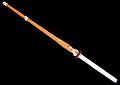
Kendo is expert wearing a traditional Japanese fashion of clothing, protective armor ( 防具 , bōgu ) and using one or, less unremarkably two, shinai ( 竹刀 , shinai ).[34]
-
-
-
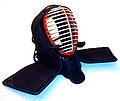
Men ( 面 )
-
-

-

Kote ( 小手 )
-

Armour and wear components
Equipment [edit]
The shinai is meant to represent a Japanese sword (katana) and is made up of four bamboo slats which are held together by leather fittings. A modern variation of a shinai with carbon fiber reinforced resin slats is also used.[35] [36]
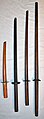
Kendōka likewise use hard wooden swords ( 木刀 , bokutō ) to exercise kata.[37]
Kendo employs strikes involving both one border and the tip of the shinai or bokutō.
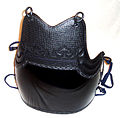
Protective armor is worn to protect specified target areas on the caput, artillery, and torso. The head is protected by a stylized helmet, called men ( 面 ), with a metal grille ( 面金 , men-gane ) to protect the confront, a series of difficult leather and fabric flaps ( 突垂れ , tsuki-dare ) to protect the pharynx, and padded textile flaps ( 面垂れ , men-dare ) to protect the side of the cervix and shoulders. The forearms, wrists, and easily are protected by long, thickly padded textile gloves called kote ( 小手 ). The trunk is protected by a breastplate ( 胴 , dō ), while the waist and groin area are protected by the tare ( 垂れ ), consisting of three thick vertical cloth flaps or faulds.
Vesture [edit]
The clothing worn under the bōgu contain a jacket (kendogi or keikogi) and hakama, a garment separated in the eye to class ii wide trouser legs.[38]
A cotton fiber towel ( 手拭い , tenugui ) is wrapped around the head, under the men, to absorb perspiration and provide a base for the men to fit comfortably.
Modern practice [edit]
Kendo preparation is quite noisy in comparison to some other martial arts or sports. This is considering kendōka use a shout, or kiai ( 気合い ), to limited their fighting spirit when hit. Additionally, kendōka execute fumikomi-ashi ( 踏み込み足 ), an activeness like to a stamp of the front foot, during a strike.
Like some other martial arts, kendōka train and fight barefoot. Kendo is ideally practiced in a purpose-built dōjō, though standard sports halls and other venues are frequently used. An appropriate venue has a clean and wooden sprung floor, suitable for fumikomi-ashi.[32]
Kendo techniques contain both strikes and thrusts. Strikes are only made towards specified target areas ( 打突-部位 , datotsu-bui ) on the wrists, caput, or body, all of which are protected by armor. The targets are men, sayu-men or Yoko-men (upper, left or correct side of the men), the right kote at any time, the left kote when it is in a raised position, and the left or right side of the dō. Thrusts ( 突き , tsuki ) are only allowed to the throat. Nevertheless, since an incorrectly performed thrust could cause serious injury to the opponent'due south cervix, thrusting techniques in free practice and contest are oftentimes restricted to senior dan graded kendōka.
-

Kendōka perform sonkyo after combat.
-

Two kendōka in tsuba zeriai.
-

Kendo target areas, or datotsu-bui.
-
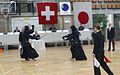
Two kendōka, one (left) is playing in nitō (ii sword style) and the other (correct) is playing in ittō (one sword manner).
Once a kendōka begins practice in armor, a exercise session may include any or all of the post-obit types of practice:
- Kirikaeshi ( 切り返し )
- Striking the left and right men target points in succession; practicing centering, distance, and correct technique while building spirit and stamina.
- Waza-geiko ( 技稽古 )
- Waza or technique practice in which the educatee learns and refines the techniques of kendo with a receiving partner.
- Kakari-geiko ( 掛稽古 )
- Short, intense, attack practice which teaches continuous alertness and readiness to attack, as well as building spirit and stamina.
- Ji-geiko ( 地稽古 )
- Undirected practice where the kendōka tries all that has been learned during exercise confronting an opponent.
- Gokaku-geiko ( 互角稽古 )
- Practice between ii kendōka of similar skill level.
- Hikitate-geiko ( 引立稽古 )
- Exercise where a senior kendōka guides a junior through do.
- Shiai-geiko ( 試合稽古 )
- Competition do which may also be judged.
Techniques [edit]
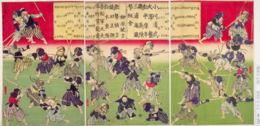
Techniques are divided into shikake-waza (to initiate a strike) and ōji-waza (a response to an attempted strike).[32] Kendōka who wish to employ such techniques during practice or competitions oftentimes practice each technique with a motodachi. This is a process that requires patience. The kendōka and motodachi exercise the technique slowly at first; as familiarity and conviction build, they increment the speed to the level used in matches and competitions.
Shikake-waza [edit]
These set on techniques are used to create an opening in an opponent by initiating an attack, or hitting boldly when the opponent has created an opening. Such techniques include:
- Tobikomi-waza
This is a technique used when one's opponent has weak kisei (spirit, vigor) or when they yield an opening under force per unit area. Ever concord kisei and strike speedily.
- Hikibana-waza
Body and shinai will lose balance as the initiator strikes or when being attacked. This technique takes reward of this to help execute a strike. A good example is Hikibana-kote when a strike is made to an opponent'due south kote as they feel threatened and enhance their kensen equally the initiator pushes forrard.
- Katsugi-waza
This provides a surprise attack by lifting the shinai over the initiator's shoulder before striking. Here a skillful apply of the kensen and spirited attack is crucial for effective katsugi-waza or luring the opponent into breaking their posture.
- Nidan-waza
There are two types. The start is for moving to the next waza after a failed outset strike, and the second holds the opponent'due south attention and posture to create the opening for a 2nd strike. The one-time requires a continuous rhythm of correct strikes. The latter requires continuous execution of waza, to take reward of the opponent'southward opening.
- Harai-waza
This tin exist used if i's opponent'southward stance has no opening when the opponent tries to assail. The opponent's shinai is either knocked down from above or swept up from below with a resulting strike just when their opinion is cleaved.
- Debana-waza
This technique involves hitting the opponent every bit they are about to strike. This is because their concentration will exist on striking and their posture will have no flexibility to reply. Thus debana-waza is ideal. This can be to whatsoever part of the opponent's body, with valid strikes being: debana-men, debana-kote, and debana-Tsuki.
Oji-waza [edit]
These counter-attack techniques are performed by executing a strike after responding or avoiding an attempted strike by the opponent. This tin can also be achieved by inducing the opponent to attack, and then employing one of the Oji-waza.
- Nuki-waza
Avoiding an attack from another, then instantly responding. Here, timing has to exist right. A response that is likewise slow or fast may not be effective. Therefore, close attention to an opponent's every move is required.
- Suriage-waza
If struck by an opponent's shinai, this technique sweeps up their shinai in a rising-slide move, with the right (ura) or left (omote) side of the shinai. And then strike in the management of their shinai, or at the opening resulting from their sophistication's collapse. This technique needs to be polish. That is, don't split up the rising-slide move and the upward-sweeping motion or it will not be successful. Valid strikes include: men-suriage-men, kote-suriage-men, men-suriage-exercise, kote-suriage-kote, and Tsuki-suriage-men.
- Uchiotoshi-waza
This waza knocks an opponent'south shinai to the right or left. This neutralises a potential strike and gives the platonic chance to strike as an opponent is off-residuum. For success, the distance between oneself and the opponent has to be correctly perceived, and then i knocks down their shinai earlier their arm fully extends. Valid strikes include: do-uchiotoshi-men and Tsuki-uchiotoshi-men.
- Kaeshi-waza
This technique is a response. Equally the opponent strikes, the opponent parries their shinai with the initiator'south. They and so flip over (turn over the hands) and strike their reverse side. Valid strikes include: men-kaeshi-men, men-kaeshi-kote, men-kaeshi-exercise, kote-kaeshi-men, kote-kaeshi-kote, and do-kaeshi-men.
Rules of Competition [edit]

At the European Championships in Bern 2005. The kendōka to the right may have scored a point to the kote.
A scorable point ( 有効打突 , yūkō-datotsu ) in a kendo competition (tai-kai) is defined equally an authentic strike or thrust fabricated onto a datotsu-bui of the opponent's kendo-gu with the shinai making contact at its datotsu-bu, the competitor displaying loftier spirits, correct posture and followed by zanshin.[39] [ clarification needed ]
Datotsu-bui or signal scoring targets in kendo are defined as:[40]
- Men-bu, the top or sides of the head protector (sho-men and sayu-men).
- Kote-bu, a padded area of the right or left wrist protector (migi-kote and hidari-kote).
- Exercise-bu, an surface area of the right or left side of the armour that protects the torso (migi-do and hidari-do).
- Tsuki-bu, an area of the caput protector in front of the pharynx (Tsuki-dare).
Datotsu-bu of the shinai is the forward, or blade side (jin-bu) of the top tertiary (monouchi) of the shinai.[40]
Zanshin ( 残心 ), or continuation of sensation, must be nowadays and shown throughout the execution of the strike and the kendōka must be mentally and physically ready to assault again.
In competition, there are usually three referees ( 審判 , shinpan ). Each referee holds a ruby flag and a white flag in opposing hands. To award a betoken, a referee raises the flag corresponding to the colour of the ribbon worn by the scoring competitor. Ordinarily, at to the lowest degree two referees must hold for a bespeak to be awarded. Play is stopped after each indicate is awarded.
Kendo competitions are usually a three-betoken match. The first competitor to score two points, therefore, wins the lucifer. If the time limit is reached and just one competitor has a point, that competitor wins.
In the case of a necktie, there are several options:
- Hiki-wake ( 引き分け ): The friction match is declared a draw.
- Enchō ( 延長 ): The match is continued until either competitor scores a point.
- Hantei ( 判定 ): The victor is decided by the referees. The three referees vote for victor past each raising one of their respective flags simultaneously.[41]
Important kendo competitions [edit]
The All Nippon Kendo Title is regarded as the near prestigious kendo championship. Despite information technology existence the national title for but Japanese kendōka, kendo practitioners all over the world consider the All Japan Kendo Title every bit the title with the highest level of competitive kendo. The World Kendo Championships have been held every 3 years since 1970. They are organised by the International Kendo Federation (FIK) with the support of the host nation'southward kendo federation.[42] The European championship is held every year, except in those years in which in that location is a world championship.[43] Kendo is besides one of the martial arts in the World Combat Games.
Advocacy [edit]
Grades [edit]
Technical achievement in kendo is measured by advancement in class, rank or level. The kyū ( 級 ) and dan ( 段 ) grading organisation, created in 1883,[44] is used to bespeak one's proficiency in kendo. The dan levels are from showtime-dan ( 初段 , sho-dan ) to 10th-dan ( 十段 , jū-dan ). In that location are unremarkably six grades below kickoff-dan, known every bit kyu. The kyu numbering is in contrary lodge, with first kyu ( 一級 , ikkyū ) beingness the class immediately below showtime dan, and 6th kyu ( 六級 , rokkyū ) being the lowest form. There are no visible differences in dress between kendo grades; those beneath dan-level may dress the same as those above dan-level.[45]
In Japan, kyu ranks are by and large held past children. The exam for 1st kyu (ikkyū) is ofttimes their outset test and grade. Adults mostly will practice their 1st dan (shodan) every bit their showtime examination.[ citation needed ] In most other countries outside of Japan, kendoka go through every kyu rank before being eligible for dan ranks.
Eighth-dan ( 八段 , hachi-dan ) is the highest dan grade attainable through a test of concrete kendo skills. In the AJKF, the grades of 9th-dan ( 九段 , kyū-dan ) and tenth dan (十段 ( jū-dan )) are no longer awarded, but ninth-dan kendōka are still active in Japanese kendo. International Kendo Federation (FIK) grading rules allow national kendo organisations to establish a special committee to consider awarding these grades. Only v at present-deceased kendōka were e'er admitted to the rank of 10th-dan following the establishment in 1952 of the All Nippon Kendo Federation. These five kendōka, all of whom were students of Naitō Takaharu at the Budo Senmon Gakko,[46] are:
- Ogawa Kinnosuke 小川 金之助 (1884-1962)- awarded 1957
- Moriji Mochida (aka Mochida Moriji) 持田 盛二 (1885-1974)- awarded 1957
- Nakano Sousuke 中野 宗助 (1885-1963)- awarded 1957
- Saimura Gorou 斎村 五郎 (1887-1969)- awarded 1957
- Ooasa Yuuji 大麻 勇次 (1887-1974)- awarded 1962
All examination candidates confront a panel of examiners. A larger, more qualified panel is unremarkably assembled to appraise the higher dan grades. Kendo examinations typically consist of jitsugi, a demonstration of the skill of the applicants, Nihon Kendo Kata, and a written exam. The eighth-dan kendo exam is extremely difficult, with a reported pass rate of less than 1 percentage.[47]
| Form | Requirement | Age requirement |
|---|---|---|
| one-dan | 1-kyū | At least xiii years erstwhile |
| two-dan | At least 1 year of preparation after receiving 1-dan | |
| 3-dan | At least 2 years of training later on receiving 2-dan | |
| 4-dan | At to the lowest degree 3 years of training after receiving iii-dan | |
| 5-dan | At to the lowest degree 4 years of training after receiving 4-dan | |
| 6-dan | At least 5 years of training afterward receiving v-dan | |
| seven-dan | At least 6 years of training after receiving 6-dan | |
| 8-dan | At least 10 years of preparation after receiving 7-dan | At least 46 years old |
Titles [edit]
Titles ( 称号 , shōgō ) can be earned in add-on to the in a higher place dan grades by kendōka of a defined dan form. These are renshi ( 錬士 ), kyōshi ( 教士 ), and hanshi ( 範士 ). The championship is affixed to the front end of the dan grade when said, for instance renshi roku-dan ( 錬士六段 ). The qualifications for each title are below.
| Championship | Required grade | Conditions |
|---|---|---|
| renshi ( 錬士 ) | half-dozen-dan | After receiving 6-dan, one must expect 1 or more years, pass screening by the kendo organization, receive a recommendation from the regional organization president then pass an test on kendo theory. |
| kyōshi ( 教士 ) | renshi 7-dan | Later on receiving 7-dan, one must wait two or more years, pass screening by the kendo arrangement, and receive a recommendation from the regional organization president, then pass an exam on kendo theory. |
| hanshi ( 範士 ) | kyōshi 8-dan | After receiving eight-dan, 1 must wait viii or more than years, laissez passer screening by the kendo arrangement, receive a recommendation from the regional organisation president and the national kendo organisation president, then pass an exam on kendo theory. |
Kata [edit]
Kata are fixed patterns that teach kendōka the basic elements of swordsmanship. The kata include fundamental techniques of attacking and counter-attacking, and accept useful practical awarding in general kendo. In that location are ten Nihon Kendō Kata ( 日本剣道形 ). These are more often than not practiced with wooden swords ( 木刀 , bokutō or bokken ). Occasionally, real swords or swords with a blunt border, called kata-yō ( 形用 ) or ha-biki ( 刃引 ), may be used for display of kata.[48]
All are performed by two people: the uchidachi ( 打太刀 ), the teacher, and shidachi ( 仕太刀 ), the student. The uchidachi makes the offset movement or assault in each kata. Equally this is a teaching part, the uchidachi is e'er the losing side, thus allowing the shidachi to learn and to gain confidence.[48]
Kata one to 7 are performed with both partners using a normal length wooden sword. Kata eight to ten are performed with uchidachi using a normal length weapon and shidachi using a shorter one (kodachi).[48]
The forms of the Nihon Kendō Kata ( 日本剣道形 ) were finalized in 1933 based on the Dai nippon Teikoku Kendo Kata, composed in 1912.[49] It is impossible to link the individual forms of Dai nippon Teikoku Kendo Kata to their original influences, although the genealogical reference diagram does indicate the masters of the various committees involved, and it is possible from this to decide the influences and origins of Kendo and the Kata.[50]
In 2003, the All Japan Kendo Federation introduced Bokutō Ni Yoru Kendō Kihon-waza Keiko-hō ( 木刀による剣道基本技稽古法 ), a set of basic exercises using a bokuto. This form of practice is intended primarily for kendōka upward to second dan ( 二段 , ni-dan ), but is very useful for all kendo students who are organized nether FIK.[48]
Kata can as well be treated as competitions where players are judged upon their operation and technique.[51] [52]
National and international organizations [edit]
Many national and regional organizations manage and promote kendo activities outside Nippon. The major organizing body is the International Kendo Federation (FIK). The FIK is a not-governmental international federation of national and regional kendo organisations. An aim of the FIK is to provide a link between Japan and the international kendo community and to promote and popularize kendo, iaido and jodo. The FIK was established in 1970 with 17 national federations. The number of affiliated and recognized organizations has increased over the years to 57 (as of May 2015).[53] The FIK is recognized by SportAccord as a 'Full Member'.[54] and by the World Anti-Doping Agency.[55]
Other organizations that promote the study of Japanese martial arts, including kendo, are the Dai Japan Butoku Kai (DNBK) and the International Martial Arts Federation (IMAF). The electric current DNBK has no connection to the pre-war organization, although it shares the same goals. The International Martial Arts Federation (IMAF) was established in Kyoto in 1952 and is dedicated to the promotion and development of the martial arts worldwide, including kendo.[22]
See also [edit]
- Angampora
- Banshay
- Bataireacht
- Bōjutsu
- Fencing
- Gatka
- Gendai budō - mod Japanese martial arts
- Geography of kendo
- Iaidō - sword drawing
- Jōdō - a martial art using a curt wooden staff, or stick
- Jūkendō
- Kalaripayattu
- Kenjutsu
- Krabi–krabong
- Kumdo - Korean kendo
- Kuttu Varisai
- Mardani khel
- Miyamoto Musashi
- Miyamoto Musashi Budokan
- Naginata - a martial art using a glave-like weapon
- Silambam
- Silambam Asia
- Swordsmanship
- Tahtib
- Thang-ta
- Varma kalai
- World Silambam Clan
References [edit]
- ^ Larkins, Damian (24 March 2016). "Kendo: The style of the sword keeping skills abrupt". ABC News . Retrieved 16 January 2020.
- ^ "剣道・居合道・杖道を知る". 全日本剣道連盟. Retrieved 26 November 2021.
- ^ "Kenjutsu".
- ^ a b Yoshio, Mifuji, ed. (31 October 2009), Budo: The Martial Means of Nihon, translated by Dr Alexander Bennett, Tokyo: Nippon Budokan Foundation, p. 335 .
- ^ Nippon Kendo Kata Instruction Manual. Tokyo: All Japan Kendo Federation. 29 March 2002. p. 1.
- ^ a b c "The History of Kendo". All Nihon Kendo Federation (AJKF). Archived from the original on 19 March 2016.
- ^ a b Tamio, Nakamura (3 January 2007). "The History of Bogu". Jikishin Kage-ryu Kenjutsu. Published with the permission of Kendo Globe. Archived from the original on eighteen Feb 2020. Retrieved 23 August 2020.
- ^ Chiba, Eiichiro (1942). Chiba Shusaku Ikoshu. Tokyo, Japan. p. xiv. ISBN978-4-88458-220-3. (in Japanese)
- ^ Hall, David (25 March 2013). Encyclopedia of Japanese Martial Arts. p. xiv. ISBN978-1568364100. (in English)
- ^ Skoss, Diane (April 2002). Keiko Shokon (Classical Warrior Traditions of Japan). p. xiv. ISBN978-1890536060. (in English)
- ^ Thomas A. Light-green; Joseph R. Svinth (11 June 2010). Martial Arts of the World: An Encyclopedia of History and Innovation [2 volumes]: An Encyclopedia of History and Innovation. ABC-CLIO. p. 600. ISBN978-i-59884-244-9.
- ^ Sasamori, Junzo; Warner, Gordon (June 1989). This Is Kendo: The Art of Japanese Fencing. Tuttle Publishing. p. 57. ISBN978-0-8048-1607-6.
- ^ Sansom, George (1961). A History of Japan: 1334–1615. Stanford: Stanford University Press. OCLC 1035605319
- ^ a b Guttmann, Allen (2001). Japanese Sports: A History. University of Hawaii Printing. pp. 106–107. ISBN9780824824648 . Retrieved 29 October 2018.
- ^ Sanchez Garcia, Raul (2018). The Historical Folklore of Japanese Martial Arts. Routledge. ISBN9781351333795 . Retrieved 27 November 2018.
- ^ Green, Thomas A.; Svinth, Joseph R. (2010). Martial Arts of the World: An Encyclopedia of History and Innovation. Vol. 2. ABC-CLIO. pp. 600–1. ISBN978-1-59884-244-9.
- ^ Svinth, J.R. (December 2002). "Documentation Regarding the Budo Ban in Japan, 1945–1950". Periodical of Antagonistic Sport. ISSN 1492-1650.
- ^ Matunobu, Yamazaki and Nojima (1989), 剣道 (Kendo), Seibido Sports Series (27), Seibido Publishers, Tokyo (in Japanese)
- ^ Budo. The Martial Ways of Nippon. Tokyo, Japan: Nippon Budokan Foundation. 1 October 2009. p. 141. Archived from the original on 27 August 2007. Retrieved 12 June 2012.
- ^ Ozawa, Hiroshi (31 July 1997). Kendo: the definitive guide. Tokyo, Japan: Kodansha International. p. xiv. ISBN978-4-7700-2119-9.
- ^ International Kendo Federation
- ^ a b "FAQ". International Martial Arts Federation (IMAF).
- ^ a b c Philippe, Mesmer (27 May 2015). "Kendo in search of renewed popularity in Japan". Le Monde.
- ^ Kikou, Yamata (1998). The calendar month without gods. Lyon: Jacques André. pp. one–11. ISBN2907922610. OCLC 421685989.
- ^ "Press conference by MM. Jacques Chirac, President of the Commonwealth, and Ryutaro Hashimoto, Prime Minister of Japan, on the orientations of the Franco-Japanese cooperation plan entitled "xx actions for the year 2000", Tokyo on November xviii, 1996". xviii Nov 1996.
{{cite web}}: CS1 maint: url-status (link) - ^ "Budokan". 2009.
{{cite spider web}}: CS1 maint: url-status (link) - ^ "宮本武蔵顕彰武蔵武道館 - Budokan Miyamoto Musashi".
{{cite web}}: CS1 maint: url-status (link) - ^ Allison, Nancy (1999). The Illustrated Encyclopedia of Torso-Mind Disciplines. Taylor & Francis. p. 293. ISBN978-0-8239-2546-9.
- ^ Tokeshi, Jinichi (2003). Kendo: Elements, Rules, and Philosophy . University of Hawaii Press. p. 271. ISBN978-0-8248-2598-0.
- ^ Sasamori & Warner 1989, p. 69
- ^ "Zenkoku kendō jinkō chōsa no kekka matomaru Heisei twenty-nen 05 tsuki-gō" 全国剣道人口調査の結果まとまる 平成20年05月号 (in Japanese). All Nippon Kendo Federation. March 2008. Archived from the original on 25 August 2009.
- ^ a b c Sato, Noriaki (July 1995). Kendo Fundamentals. Tokyo, Nippon: All Japan Kendo Federation.
- ^ "Concept of Kendo". All Japan Kendo Federation (AJKF). Archived from the original on 22 Apr 2017.
- ^ Sasamori, Junzō; Warner, Gordon (1964). This is Kendo: the art of Japanese fencing . Japan: Charles East. Tuttle. pp. 71–76. ISBN978-0-8048-0574-2.
- ^ Sasamori & Warner 1964, p. 70
- ^ Dilbert, Ryan (16 May 2017). "Best, Worst Uses of Kendo Stick in WWE History Ahead of Alexa Bliss vs. Bayley". Bleacher Report . Retrieved 20 July 2018.
- ^ Sasamori & Warner 1964, p. 52
- ^ Sasamori & Warner 1964, p. 71
- ^ The Regulations of Kendo Shiai and Shinpan. Tokyo, Japan: International Kendo Federation. Dec 2006. p. 5.
- ^ a b FIK Regulations 2006, p. 6
- ^ FIK Regulations 2006, p. 94
- ^ World Kendo Championships
- ^ "European Kendo Championships". Archived from the original on 22 February 2015. Retrieved iv Feb 2013.
- ^ Active Interest Media, Inc. (1991). Black Chugalug. Active Involvement Media, Inc. p. 64.
- ^ Standard Rules for Dan/Kyu Examination. Tokyo, Japan: International Kendo Federation. December 2006.
- ^ Asahi Picture News, February 1958
- ^ "Zen'japan kendō renmei" 全日本剣道連盟. kendo.or.jp. Retrieved 27 May 2014.
- ^ a b c d Nippon Kendo Kata Pedagogy Manual. Tokyo, Nihon: All Japan Kendo Federation. 29 March 2002.
- ^ Budden, Paul (2000). Looking at a Far Mountain: A Report of Kendo Kata. Tuttle. pp. 9, 12, fourteen. ISBN978-0-8048-3245-8.
- ^ Budden 2000, p. nine
- ^ "Kendo Kata Taikai". British Kendo Association. Archived from the original on 21 Feb 2014.
- ^ "Kendo Kata Taikai Rules" (PDF). British Kendo Association. Archived from the original (PDF) on 9 November 2013. Retrieved five February 2013.
- ^ "International Kendo Federation". kendo-fik.org. Archived from the original on 21 June 2018. Retrieved 13 August 2015.
- ^ "SportAccord Members". SportAccord Members. Archived from the original on 27 July 2013. Retrieved 17 September 2012.
- ^ "Alliance of Members of Sportaccord". WADA. Retrieved 17 September 2012.
External links [edit]
 | Wikimedia Commons has media related to Kendo. |
- International Kendo Federation (FIK)
- All Japan Kendo Federation (AJKF) (in Japanese)
- Dai Nippon Butoku Kai (DNBK)
- http://www.ekf-eu.com/ European Kendo Federation
Source: https://en.wikipedia.org/wiki/Kendo
0 Response to "Is It Ever Too Late to Practice Martial Arts"
Postar um comentário